


Inside the First Institutional Ethereum Breakfast
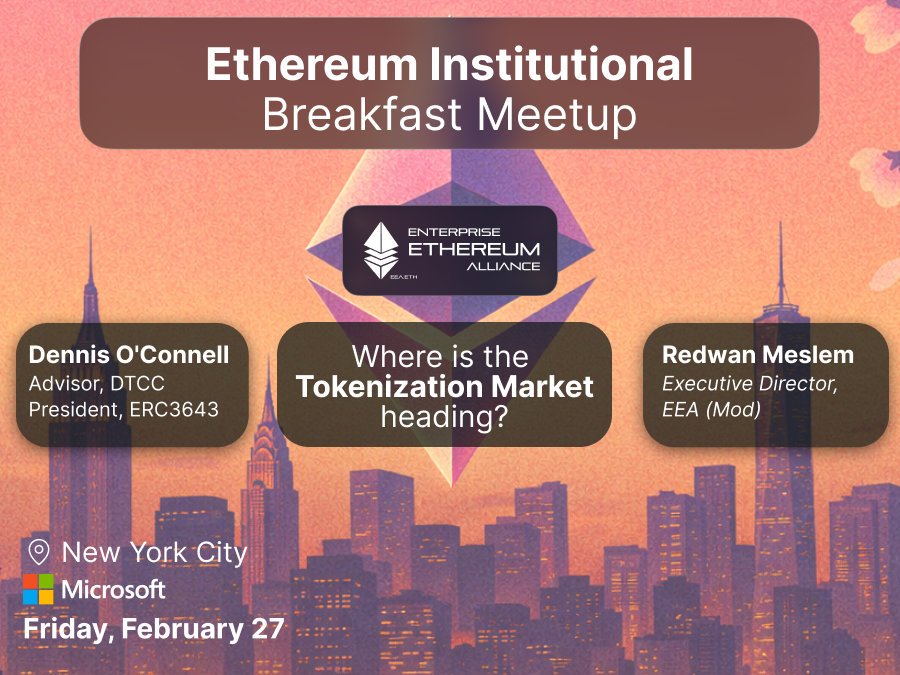
On February 27, the Enterprise Ethereum Alliance brought together financial institutions, infrastructure providers, and protocol engineering teams for the inaugural Institutional Ethereum Breakfast Series at Microsoft Garage in New York City.
The session was designed as a focused working group to explore how enterprises develop on-chain financial infrastructure within regulated environments and according to emerging standards.
Participants included representatives from DTCC, JPMorgan, EY, Polygon, Ethena, Nethermind, zkSync, and other organizations contributing to institutional Ethereum infrastructure in settlement, identity, compliance, privacy, and protocol engineering.
The discussion focused on three key implementation areas shaping enterprise adoption:
- tokenization structures and their operational readiness
- privacy architecture requirements for regulated environments
- infrastructure contributions from new EEA members
Tokenization Is Moving Into Production Infrastructure
Dennis O’Connell, President of the ERC-3643 Association and Strategic Advisor to DTCC, opened the session by highlighting ongoing developments in post-trade infrastructure.
Over the past year, DTCC has increased its focus on standardized tokenized instruments. In March 2025, DTCC joined the ERC-3643 Association to support an open token standard embedding identity, permissions, and compliance logic at the asset level. In December 2025, the Depository Trust Company received a No-Action Letter from the SEC, supporting a tokenization initiative for DTC-custodied assets, including U.S. equities and Treasury instruments.
ERC-3643 is significant because it standardizes identity verification, transfer restrictions, and programmable compliance parameters directly within financial instruments at the infrastructure layer. These embedded controls ensure that assets can move between regulated counterparties without requiring bespoke compliance logic for each transaction.
The discussion emphasized that tokenized securities are now moving beyond theory, with infrastructure actively under development and progressing toward production as part of a coordinated enterprise Ethereum ecosystem.
Privacy Architecture: The Remaining Prerequisite
Privacy remains a significant barrier to enterprise deployment on public Ethereum. Financial institutions cannot disclose transaction details, counterparty information, or portfolio positions on a transparent ledger, even when efficiency gains are evident.
The group focuses on how different privacy solutions map to enterprise requirements, including:
- Maintaining confidentiality while supporting regulatory reporting
- Meeting throughput requirements for institutional settlement
- Leveraging technologies such as zero-knowledge proofs, trusted execution environments, and encrypted computation
A structured overview of privacy approaches is being developed and will be updated twice a year to reflect ongoing technological advancements.
The breakfast also welcomed three new EEA members who provide essential infrastructure capabilities:
- Polygon Labs: offers production payment rails, processing over $7 billion in peer-to-peer stablecoin volume in a single month (Nov 2025).
- Ethena: creator of USDe, the fastest digital dollar instrument to reach $10 billion in total value locked.
- Nethermind: building execution-layer infrastructure and security tooling to ensure safe enterprise deployments.
Their participation alongside established institutions such as JP Morgan, EY, and DTCC demonstrated that the layers of enterprise Ethereum infrastructure, including payment rails, financial instruments, and protocol engineering, are becoming more coordinated. The EEA plays a central role in convening these stakeholders.
Why this Matters
The Institutional Ethereum Breakfast Series is intentionally small, recurring, and focused, with no keynote stages, sponsor logos, or large audiences.
This format is important because institutional Ethereum adoption decisions are made through detailed, trust-based discussions rather than conference panels. By facilitating in-depth operational dialogue among infrastructure, compliance, product, and risk teams, the EEA is accelerating real-world deployment.
What Comes Next
The first breakfast confirmed a key insight: enterprise Ethereum has shifted from strategic evaluation to operational coordination. Organizations are no longer debating whether to build on Ethereum; they are now aligning on how to proceed.
Future sessions will continue to convene financial institutions, infrastructure providers, and protocol teams to address practical topics, maintaining the same focused, high-value, no-pitch format.
Organizations interested in participating in future sessions or learning more about the Breakfast Series may contact the EEA directly.
